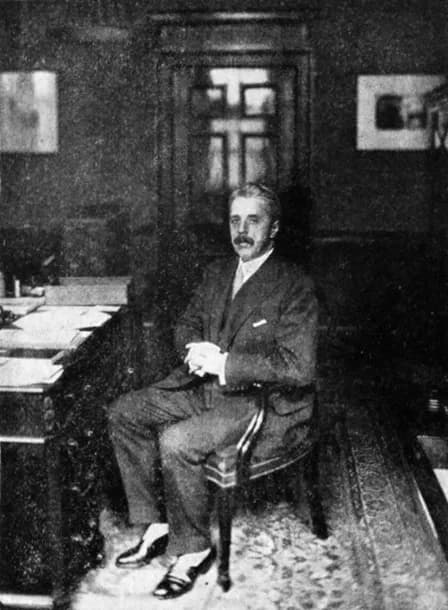
Arnold Bennett stands as Stoke-on-Trent's most celebrated literary son, a novelist who transformed the industrial landscape of the Potteries into one of English literature's most enduring fictional territories. Born in Hanley on 27 May 1867, Bennett created the "Five Towns", a literary mapping so convincing that readers still seek out its non-existent geography.
From Hanley to Literary Fame
Enoch Arnold Bennett entered the world in Hanley, the eldest of six children of Enoch Bennett, a local solicitor, and Sarah Ann Longson. His education took him to the Wedgwood Institute in Burslem and then to a grammar school in Newcastle-under-Lyme. In March 1889, aged 21, he followed the path of many ambitious provincials and moved to London, finding work as a clerk in a solicitors' firm at Lincoln's Inn Fields.
Bennett's literary career began in earnest when he became editor of Woman magazine in 1896, a position he held until 1900. That year marked his transition to full-time authorship. A pivotal move came in March 1903 when he relocated to Paris, where he lived in the 9th arrondissement and married Frenchwoman Marguerite Soulié in July 1907. This decade abroad proved formative; Paris liberated Bennett from provincial shyness and exposed him to the French realist tradition of Zola, Balzac, and Flaubert that would shape his mature style.
The Five Towns and Their Real Counterparts
Bennett's genius lay in recognising what he called the "dark splendours" of the industrial Midlands. In a letter to H.G. Wells from 1897, he wrote of the Potteries: "there is an aspect of these industrial districts which is really grandiose, full of dark splendours, & which has been absolutely missed by all novelists up to date."
The "Five Towns" of his fiction were drawn directly from Stoke-on-Trent's "Six Towns" that federated as a county borough in 1910. Bennett deliberately omitted Fenton, which he termed "the forgotten town", explaining that "Five Towns" was simply more euphonious than "Six Towns". His fictional mapping was as follows:
- Burslem became Bursley, the setting for The Old Wives' Tale and the Clayhanger family home
- Hanley became Hanbridge
- Longton became Longshaw
- Stoke became Knype
- Tunstall became Turnhill
The Major Novels
Bennett's Five Towns novels transformed English literary realism. Anna of the Five Towns, published in 1902 by Chatto & Windus, introduced readers to his fictional territory. The 360-page novel established the template: unflinching observation of working and middle-class Potteries life rendered in precise, documentary detail.
His masterpiece, The Old Wives' Tale, arrived in January 1908. Published by Chapman and Hall, the novel spans roughly 1840 to 1905, following the lives of two sisters from Bursley (the fictional Burslem). Much of the narrative unfolds in Paris, where Bennett drew upon his own experiences to depict the Siege of Paris and the Paris Commune. The novel secured his reputation; it ranked number 87 on the Modern Library's list of the 100 Best English-Language Novels of the 20th Century.
The Clayhanger series followed: Clayhanger (1910), Hilda Lessways (1911), These Twain (1915/1916), and The Roll-Call (1918). The first three volumes trace Edwin Clayhanger's journey from submissive son to independent man against the backdrop of Victorian-to-Edwardian social change. Hilda Lessways proved particularly innovative, retelling events from the woman's perspective. The success of these novels was such that Clayhanger Street in Burslem was named after the fictional family.
Portraying the Potteries
Bennett's realism preserved a world that industrial change was already transforming. At the peak of the pottery industry, some 2,000 bottle-shaped kilns dominated the Staffordshire skyline. His novels captured the "smoke-thickened" air, the distinctive social hierarchies, and the North Staffordshire dialect that characterised the region. The Oxford Companion to English Literature notes his "ironic but affectionate detachment, describing provincial life and culture in documentary detail".
Bennett credited George Moore's 1885 novel A Mummer's Wife, set in the Potteries, as "the father of all my Five Towns books". Yet where Moore was an outsider, Bennett wrote from inside the culture he described. He aimed to portray what he called the "unpoetic" lives of pottery manufacturers, shopkeepers, and artisans, finding grandeur in the ordinary.
Literary Reputation and Legacy
During his lifetime, Bennett was the most financially successful British author. The Grand Babylon Hotel sold 50,000 copies in hardback and was translated into four languages. The Oxford Companion to Edwardian Fiction dubbed him the "laureate of the commonplace". He believed literature should be accessible to ordinary people and deplored literary cliques and élites.
This populism brought criticism from modernists, most notably Virginia Woolf, who took issue with his adherence to realism and his popularity with general readers. Later critical studies by Margaret Drabble (1974) and John Carey (1992) prompted re-evaluation of his work. Clayhanger was said to have "set the seal on Bennett's reputation", and his finest novels are now recognised as major achievements.
Bennett declined a knighthood twice, reportedly hoping instead for the Order of Merit. He served briefly as director of propaganda at the Ministry of Information in the final weeks of the First World War. On 27 March 1931, he died at his flat in Chiltern Court, Baker Street, London, of typhoid fever contracted after drinking tap water in France. He was 63. Following cremation at Golders Green, his ashes were interred in Burslem Cemetery in his mother's grave.
Bennett's Stoke Today
Readers seeking Bennett's Stoke can still find traces of his world. The Gladstone Pottery Museum in Longton preserves bottle kilns that once dominated the skyline he described. Burslem retains the atmosphere of his fictional Bursley, and Clayhanger Street stands as physical testament to his legacy. His novels remain the most detailed literary record of the Potteries at the height of its industrial power, preserving voices, landscapes, and social structures that would otherwise have been lost to time.
Bennett completed 34 novels, seven volumes of short stories, 13 plays, and a daily journal totalling over one million words. Yet it is the Five Towns that secure his place in English letters, a fictional territory as enduring as Hardy's Wessex or Trollope's Barsetshire, built from the smoke, clay, and hard-won dignity of Stoke-on-Trent.